



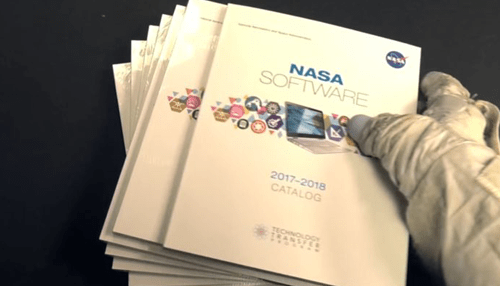

Several hundred pieces of software written by NASA engineers for air and spacecraft design, business optimization, systems interaction, and biomedical applications have been released by the agency for free public use.
The software is being made available through the NASA Technology Transfer Program (motto, “Bringing NASA Technology Down to Earth”).
The available codes are listed in the NASA Software Catalog, now in its third edition, published this week.
While much of the software is entirely in the public domain, some programs may only be released for use on a government project or are subject to export controls allowing use only by U.S. persons.
NASA awarded “Software of the Year” to two projects in 2016. The first, Traffic-Aware Planner, is an in-cockpit tool to assist pilots in requesting the most efficient route of flight taking into consideration the position and track of nearby aircraft. Captain Scott Sander, Director of Fleet Technology at Alaska Airlines, is calling TAP “a game-changing capability.”
NASA says several aerospace companies have acquired evaluation licenses to explore opportunities for commercialization. The second, Pegasus 5, is a computational fluid dynamics solver that allows users to calculate the pressure and temperature of fluid flows to model system performance, such as lift and drag from an airframe in flight.
Although likely not as popular as astronaut ice cream, the most requested piece of NASA software in 2016 was the Schedule Test and Assessment Tool, a plug-in to Microsoft Project to automate the reporting of project performance data.
For the full list of software available, see software.nasa.gov
