


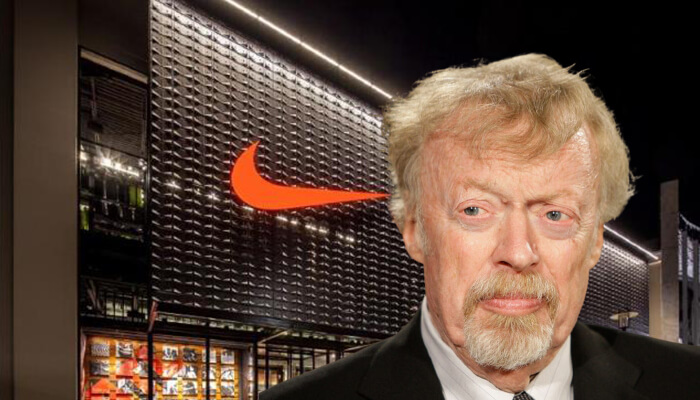

Who is Phil Knight?
Phil Knight ran at the University of Oregon on a track, and he created Nike shoes. He did it with Bill Bowerman, his track coach. They put up $500 each to start Nike and began as Blue Ribbon Sports.
How did Phil Knight come up with Nike?
Phil Knight, in 1958, was at the University of Oregon as a business major and as a track team miler. Phil disliked the American running shoe’s clumsiness and shared his dissatisfaction with Bill Bowerman, his coach. In 1964, they began marketing campaigns for comfortable shoes with Bowerman designs.
Background of Phil Knight and Nike start
Phil Knight, born on February 24, graduated in 1959 with a journalism degree from the University of Oregon. He served a year in the army and went on to pursue his MBA from Stanford’s Graduate School of Business.
Knight came up first with the Blue Ribbon Sports idea, and it later became the Nike Company. Starting with a small amount of $500 from Bill Bowerman, he tried expanding. Bowerman came up with a design, and in 1971, the rubber-waffled sole was the brand’s signature. They enjoyed a as their shoes were cheaper than Adidas.
In 1971, Nike’s rebranding was official, and well-known athletes began sporting the shoes, and the profits doubled. Bowerman and Knight’s connection was focused on high-quality products for athletes. It means professional athletes found Nike their appropriate choice.
As supply chain management, in 1972, Nike Cortez launched at the Olympics in Munich, and it became the Olympic athlete’s choice. The Cortezes debuted with the Swoosh logo of Nike, and they became the first appealing sneakers. It has function and fusion.
It grew quickly, taking its revenue jump in 1973 from $28.7 million in 1983 to $867 million.
How did Phil Knight become popular?
In 1982, the company launched the Air Force 1 model, featuring Nike Air. This shoe had cushioning in the heel as an air pocket to favor basketball players. It is the most popular sneaker, selling millions of pairs every year.
Another big accomplishment was Michael Jordan signing an endorsement deal. In 1985, It courted Jordan and signed a $500,000 yearly contract. In 1985, in March, Air Jordan was at $65 per piece, and by the end of the year, the revenue was over $100 million.
In the mid-80s, the sales of Nikes started coming down, and Knight knew it was time to shift. In 1991, he focused his supply chain management on everyday customers. It regained its footing in 1991 and escalated its sales numbers. He said everything is part of the marketing process.
Knight did not concentrate only on selling shoes. He said he was a part of the entertainment business and not the shoe business. Nike in the 90s faced obstacles, with customers boycotting the brand for a decade.
By 1998, sales dropped, and layoff staffing became compulsory. Knight came up with drastic changes, aiming to save his brand with marketing campaigns. He raised workers’ wages, improved labor practices, and ensured clean air within factories.
The brand controls athletic footwear brands and has been a powerhouse. Knight owns two private jets, the Gulfstream G-V and the 2013 Gulfstream G650, and $21.6 billion.
Wrapping Up
Phil Knight, the creator of Nike, devoted 51 years and stepped down as chairman when he was 77 years old. He is holding the reins, and it hopes to rename it soon.
